
The Hidden Inefficiency in Plain Sight
Walk through a Danish field and you are looking at the result of a particular historical choice. That choice made sense when it was made. In the mid-20th century, agriculture faced a different problem: how to feed a growing population with fewer people. The answer was mechanization and specialization. We moved from 60% of the people producing the food to 2% of the people. This was genuine progress. It freed billions of hours for other work.
But this optimization created a system with a fundamental inefficiency baked into its structure. We now grow crops primarily to feed to livestock, which we then eat. This is energy-inefficient at scale. A field of grass contains 18-20% protein. Wheat contains 8-9%. Yet we grow wheat primarily to feed chickens and pigs, when we could feed people more directly. As Jensen notes, "You get approximately, in comparison to a feed field of wheat, you get about two and a half times as much protein from a field of grass."
This is not a bug in the current system. It is a feature of how optimization works. When you optimize for one variable (labor efficiency, mechanical harvestability, established supply chains), you often create blind spots elsewhere (nutritional efficiency, land use efficiency, regenerative capacity). The system works well within its constraints. But the constraints have changed. We no longer have the luxury of accepting 2.5 times protein loss as the cost of doing business.
The Debt Model. Why Soil Matters More Than You Think
There is a useful metaphor embedded in how regenerative agriculture thinks about soil. Jensen describes it this way: "Use the land in a way that reduces the debt and over turn, builds up a surplus of nutrients and of carbon in the soil." This language of debt and surplus is revealing. It suggests that conventional agriculture treats soil like a bank account you withdraw from. Regenerative agriculture treats it like an investment account where you can compound returns.
Most industrial farmland has been run as a withdrawal system for decades. The farmer extracts nutrients, sells them as crops or livestock, and replaces them with synthetic inputs. This works until the underlying resource (soil structure, microbial diversity, carbon content) degrades enough that the synthetic inputs stop compensating. You hit a wall. The system does not fail suddenly. It fails gradually, then all at once.
One specific example reveals how deep this problem goes. Peatlands make up a small fraction of Denmark's farmland, but they account for approximately one-third of agricultural greenhouse emissions. This seems impossible until you learn why. Drained peatlands oxidize. They are essentially a stored carbon bank that starts releasing what it has held for millennia. You can farm them for years, even decades, pulling out more value in that period than you could from mineral soil. But you are borrowing against a finite resource. Re-wetting these lands is part of the solution, but it requires a fundamentally different model of what farmland is for.
This debt-and-surplus framework applies beyond agriculture. You see it in fisheries (overharvesting until the stock crashes), in aquifers (drawing down groundwater faster than it recharges), in forests (harvesting at rates that exceed growth). Any system that treats a renewable resource as if it were infinite will eventually face the same wall. The solution in every case requires the same shift: from extraction to regeneration, from linear to circular.
Biochar and the Art of Returning What Was Taken
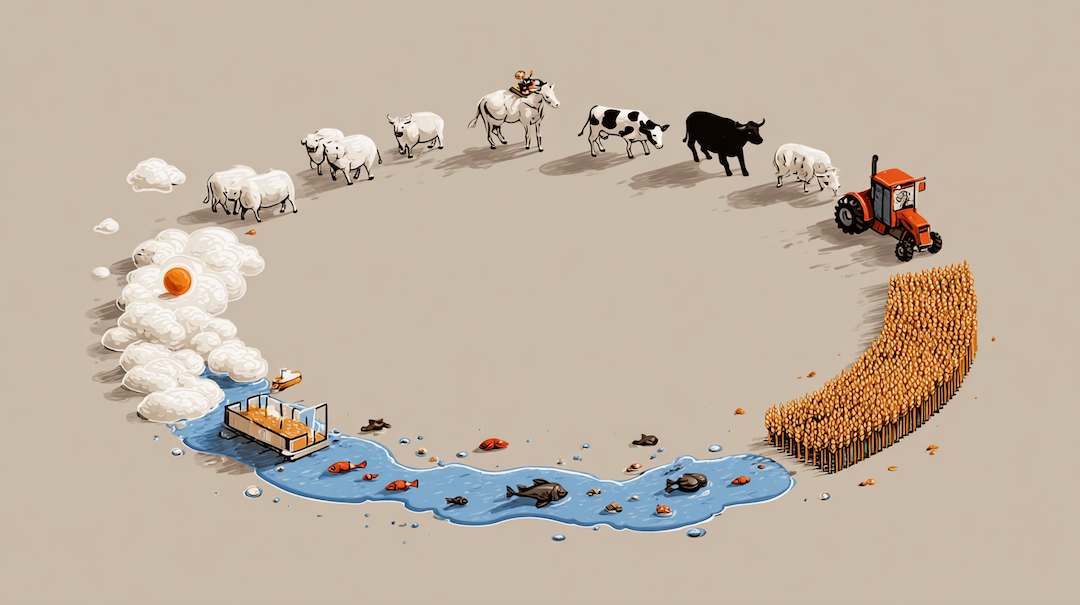
One of the more elegant solutions emerging from Danish agricultural innovation involves a technology called pyrolysis. The concept is straightforward. Take agricultural residues (straw, husks, plant matter that would otherwise be burned or left to rot). Heat them to high temperatures in low-oxygen conditions. What remains is biochar: a form of carbon-rich material that looks like fine charcoal.
The magic is in what happens next. Biochar is placed back in the soil, where it does two things simultaneously. First, it acts as a nutrient reservoir and habitat for soil microbes, improving soil structure and water retention. Second, it sequesters carbon. The carbon in that biochar will not oxidize back into the atmosphere as carbon dioxide. It will stay in the soil for centuries, maybe longer. You have taken carbon that was in the air, converted it to a plant, then converted that plant to a stable form, and returned it to where it belongs.
This is a pattern worth recognizing. It appears in different forms across many domains. A library sequesters knowledge in a form that does not decay. A legal precedent sequesters a decision in a form that shapes future decisions. A vaccine sequesters immunity in a form that persists. In each case, you are taking something valuable and converting it to a more stable form for long-term benefit. The specific mechanism differs. The principle is identical.
Biochar is not a complete solution to agriculture's carbon problem. But it is indicative of the kind of thinking required: find the waste streams in your current system, understand what value they contain, and redesign the process to capture that value rather than discard it.
Strip Cropping and the Autonomy Dividend
Another transformation emerging is less about what we grow and more about how we grow it. Strip cropping with robotic fleets represents a shift from centralized monoculture to distributed diversity. Instead of planting an entire field to one crop, you plant narrow strips of different crops. Then small autonomous machines manage each strip independently, optimizing conditions for that specific crop.
Jensen describes it this way: "A fleet of small machines driving autonomously, managing different strips." This does several things at once. Biodiversity increases because you have more crop variety in the same space. Pest management becomes easier because insects that prey on one crop can be isolated. Soil stress decreases because you are not exhausting the same nutrients year after year. The system becomes more resilient because failure in one strip does not cascade across the entire field.
But notice what has changed in the underlying economics. Machines could not manage strips effectively when each strip had to be individually profitable. The coordination cost was too high. Now it is not. Autonomous systems have fallen in price and capability to the point where strip cropping becomes economically viable at scales that were impossible before. Technology did not solve the problem directly. It solved a constraint that was preventing a better solution from being economically feasible.
This pattern repeats across industries. Renewable energy could not scale until battery costs fell enough to solve the storage problem. Distributed manufacturing could not scale until digital design tools became precise enough to allow small-scale production of complex parts. The bottleneck is often not the core innovation. It is the enabling condition that unlocks the innovation.
The Waste Problem. One-Third of the System We Have Not Optimized
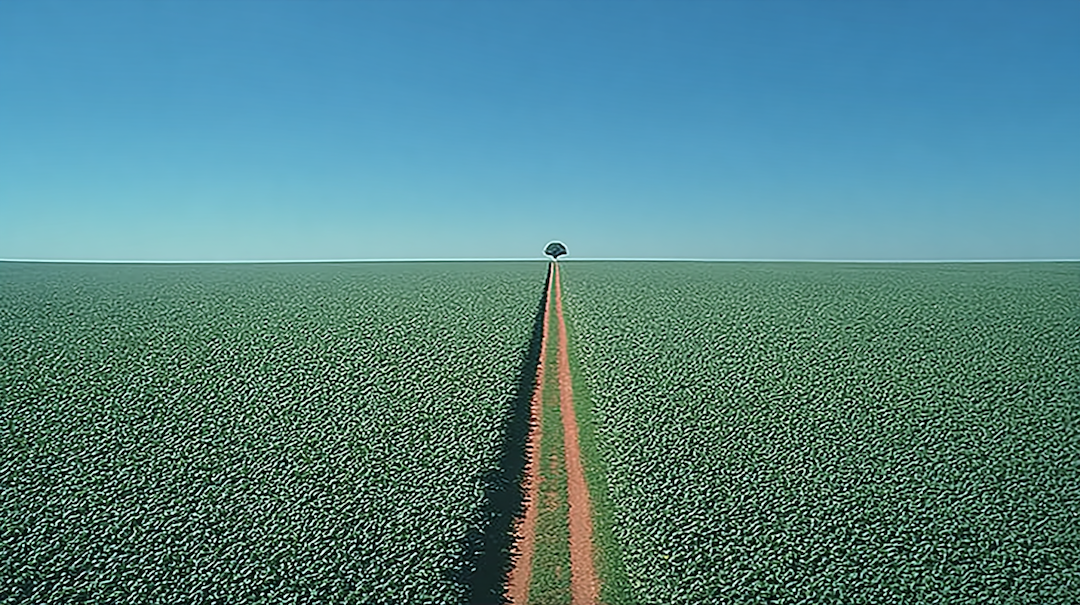
Here is a fact that should stop you: approximately one-third of food produced globally is wasted. Not consumed. Not distributed. Wasted. This is not a failure of agriculture. It is a failure of the entire system that comes after agriculture. It is a failure of logistics, storage, retail incentives, and consumer behavior.
But there is also a technological angle that points to something deeper. Measurement technology is improving. You can now determine with high precision not just when food will spoil, but when each specific item will spoil. Ugly vegetables (nutritionally identical to beautiful ones) can now be sorted and tracked as a separate supply chain rather than discarded. These are small changes. But small changes in measurement often precede large changes in systems.
Once you can measure something precisely, you can optimize it. Once you can optimize it, you can build economics around it. The visible benefit is in food waste reduction. The deeper lesson is about hidden value. We throw away one-third of our food not because it is spoiled but because we cannot measure it. We cannot track it. We cannot route it efficiently. The vegetables are not ugly. Our system is blind.
The 10-Year Problem. Why Speed Matters More Than Perfection
All of this requires a shift in perspective about timescale. Jensen makes an observation that deserves to be stated plainly: "It took wind 20 years, maybe 25, 30 years to become a profitable business on its own. You need to have the same perspective, only the fact that we have to do it in 10 years or 15 years, instead of doing it in long term."
Wind energy was allowed decades to mature. The learning curve was long. The failures were distributed over time. The system had patience. Agriculture does not. The population will hit 9-11 billion in a window measured in years, not decades. The farmland constraint will tighten every season. The window for innovation is compressed by a factor of two or three compared to previous transformations.
This creates a different kind of pressure. You cannot wait for the perfect solution. You have to deploy adequate solutions now, learn from them, improve them in parallel. This is transformation at speed. It requires accepting that some approaches will not work out. It requires building redundancy into your innovation pipeline. It requires being willing to fail in specific domains so you do not fail in the system as a whole.
The math is unforgiving: 60% productivity increase, 20% less land, 45% more demand. No amount of incremental improvement within the current structure will close that gap. You need transformation. You need to change not just how much you produce but how you produce, what you produce, and what you do with the waste streams of production.
What is happening in Danish agriculture is not unique to food. It is a model for what happens when linear optimization hits a wall. You cannot negotiate with physics or ethics. You cannot ask for more land or more time. You must change the architecture. This requires seeing inefficiencies that were hidden by previous optimization (80% of crops feeding animals instead of humans). It requires developing new technologies that make better approaches economically viable (autonomous fleets that manage strip crops). It requires reclaiming waste streams that were previously ignored (biochar, precision spoilage dating, ugly vegetables).
The mechanisms at work here appear in other domains where systems are under pressure: energy transition, circular economy, resource management, even organizational change. When you face a constraint that cannot be negotiated, the path forward is not to work harder. It is to rethink the structure itself. The good news is that rethinking often reveals efficiencies and value that were always there, just invisible to the old way of seeing. The bad news is that you have to do it in 10 years instead of 30.