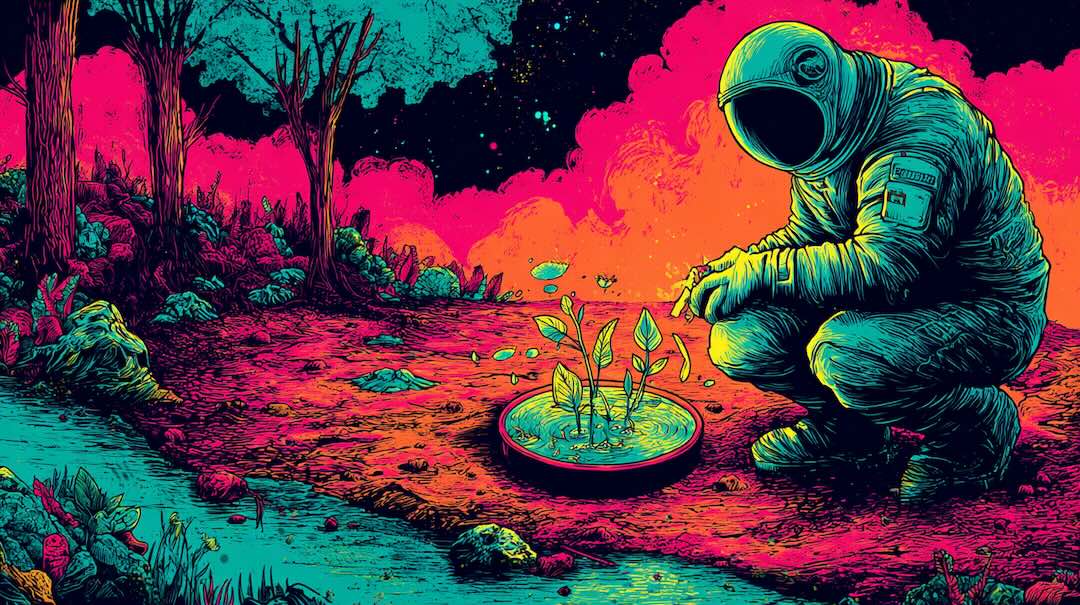
The most honest thing Kai Finster said in our conversation was also the most disorienting. I had asked him whether we are alone in the universe, and he told me that nobody can answer that question. What scientists can do is build a framework for thinking about how likely it is. And the entire framework, every mission, every instrument, every search criterion, is built on a single data point: Earth.
Kai is a Professor of Astrobiology at Aarhus University. He is not a pessimist about the search. But he is precise about what the search actually involves, which turns out to be something stranger and more interesting than looking for aliens. Astrobiology is, at its core, an attempt to reason about universal principles from a sample size of one.
I have been thinking about that problem ever since.
The Trouble With One Example
Science generally works by comparing things. You change one variable, hold the others constant, and see what happens. You run the experiment many times. You look for patterns across a large enough population that chance cannot explain them.
Astrobiology cannot do any of that. We have exactly one confirmed example of a planet with life. We have four billion years of evolutionary history on that planet, which gives us an enormous amount of information about how life works once it exists. But we have essentially no information about whether the solutions that Earth life found — DNA, proteins, lipid membranes, water as solvent — were necessary outcomes of the conditions, or one of many possible paths that happened to work out here.
This is the epistemological problem that sits at the centre of the entire field. Kai described it straightforwardly: "Our reference for everything that we do is terrestrial life, and Earth is our model system." That is not a limitation he is unhappy about. It is simply the honest starting position. You begin with what you know.
What Earth's Solution Actually Looks Like
The chemistry of life on Earth is, once you look at it carefully, less arbitrary than it might seem. Water works as a solvent for life not just because it is common, though it is extremely common, made of two of the most abundant elements in the universe. It works because of its specific physical properties. It has a high heat capacity, which stabilises temperature and therefore stabilises the environment in which biochemical reactions can occur. It supports the formation of membranes, because compounds that attract water and compounds that repel it spontaneously organise themselves into layers when brought into contact with it. Those membranes are what make cells possible.
And cells, Kai explained, are not optional. "You need to have control over the system. Otherwise, at the moment, when the living organism loses the control, it dies." A cell is an enclosed and controlled environment in which hundreds of chemical reactions can happen simultaneously without interfering with each other. The membrane is what makes that control possible. Without it, you can have chemistry, but you cannot have the organised, self-sustaining chemistry that we call life.
This matters for the search because it suggests that water and membranes are not quirks of Earth life. They are likely solutions to problems that any form of life would face. A solvent that is stable across wide temperature ranges and supports membrane formation is not just convenient; it is probably necessary. Kai's view is that water is the most common solvent in the universe, and that gives us a reasonable basis for looking for life in places where liquid water exists or has existed.
Three Billion Years of Doing Almost Nothing
One of the things that most recalibrated my sense of what we are actually looking for is the timeline of life on Earth. Life began here roughly four billion years ago. For the first three billion of those years, almost everything was unicellular. Bacteria, archaea, simple organisms with no nucleus, no complex internal structure, nothing we would describe as interesting in the casual sense of the word. The complex multicellular life that most of us are more familiar with — animals, plants, fungi — only arrived in the last billion years.
The reason that shift happened when it did comes down to oxygen. Oxygenic photosynthesis, the process that produces oxygen as a byproduct of capturing sunlight, only evolved around 2.5 billion years ago. Before that, oxygen was extremely scarce in the atmosphere. And without oxygen, the energy transfer efficiency between levels of a food chain is so poor that a chain of more than two steps is essentially impossible. Complexity, in the biological sense, requires oxygen.
"In a world that has no oxygen in the atmosphere, I would only expect unicellular life," Kai said.
This has a direct implication for what we are looking for on Mars. Mars had liquid water early in its history. The conditions that would have been necessary for simple life to begin may well have existed. But Mars lost its magnetic field early, which led to the gradual stripping of its atmosphere by solar wind, which led to the loss of liquid water. The window during which Mars might have supported life was probably shorter than the window that produced complex life on Earth. Nobody is looking for a green man on Mars. What the scientific community is looking for is evidence of microbial life, fossilised or, in the deep subsurface, possibly still present.
What the Mars Missions Are Actually Doing
The current rover missions, Curiosity and Perseverance, are doing something more constrained than most people imagine. They are not performing experiments designed to detect life directly. They are drilling into rock, extracting material, and analysing it for organic compounds, the chemical signatures that could indicate biological activity. Perseverance is also collecting small cores and packing them into containers, with the intention that a future mission will retrieve them and eventually return them to Earth for analysis. The plan involves three separate missions and an orbital handoff. There is a lot that can go wrong.
The mission Kai finds most promising is ExoMars, the European Space Agency's planned deep-drilling mission. Previous missions have only sampled the top 20 centimetres or so of the Martian surface. At that depth, the material has been exposed to radiation for billions of years. Radiation destroys organic molecules. The ExoMars drill, if the mission reaches Mars and works as planned, will reach two metres below the surface, below the penetration depth of most of the damaging radiation, into material that may have been preserved intact for several billion years.
"This is really what we are waiting for; to get deeper," Kai told me.
Why the Answer Matters Either Way
The result that would be most scientifically significant, Kai suggested, is not finding life that looks completely alien. It is finding life that uses exactly the same biochemical solutions that Earth life uses. DNA, proteins, lipid membranes. If Mars life, evolved independently, arrived at the same answers, that tells us something profound: those answers are probably not contingent. They are probably the solutions to universal problems, and we have some hope of finding them wherever the conditions are right.
If Martian life uses mirror-image amino acids, or completely different molecular machinery, that is fascinating in a different way. It tells us that there are multiple viable paths, and that our Earth-specific expectations may miss life that is genuinely different.
Either outcome advances our understanding. Even finding definitively that Mars has never hosted life would be useful, because it would constrain what the necessary conditions actually are. The search for extraterrestrial life is unusual as a scientific programme in that almost any result would be informative.
What I keep thinking about after this conversation is how the question has changed shape on me. I came in thinking about it as a question about the universe: is there life out there? I came out thinking about it as a question about life itself: are the solutions Earth found the only solutions available, or did chemistry have other options? That is a harder question, and a more interesting one. It is also the question that four billion years of Earth biology, and every probe we have ever sent to Mars, are slowly working toward answering.