The Say-Do Gap: Why Consumer Intent Doesn't Match Action
Ask people whether we should change our food habits to address climate change and you get one answer. Watch what they actually buy at the grocery store and you get another entirely. Lars Horsholt Jensen, Chief Operating Officer at Food & Bio Cluster in Denmark, points to the research directly: "79% are willing to change their habits. So people know that this is a problem and are willing to change. At least they say they are." Yet when these same consumers face actual choices in retail, the vegan proportion represents less than 2% of total turnover across food categories.
This gap between what we say and what we do appears across multiple domains. We see it in climate action broadly, in fitness commitments, in financial behavior. What makes food unique is that the barrier isn't just about willpower or convenience. Food is layered. As Jensen explains, "Food is culture, food is practice, food is not just a technology that translate this into exactly the same experience."
The problem surfaces when plant-based products try to masquerade as exact replacements for meat or dairy. A plant-based burger tastes different. Plant milk doesn't have the probiotic properties of yogurt. When 50% of consumers say they want to eat less meat, but only 26% support meat-free days in their workplace cafeteria, you're seeing the collision between intellectual agreement and embodied habit.
Yet here's the pattern worth noticing: this gap isn't unique to plant-based foods. The alcohol-free beverage market offers a proxy. Four years ago, alcohol-free beer was a niche product for specific audiences. Today, entire supermarket aisles overflow with zero-alcohol wine, beer, spirits, and everything in between. The shift happened not through moralizing about reduced consumption, but through repositioning these products as tools for health and performance rather than as compromises.
Why Efficiency Matters More Than You Think
Step back from the dinner table for a moment and the logic becomes stark. "Today, we take those proteins, we grow them in the field, we feed them to the animals, then we eat the animals," Jensen says. "And animals, especially cows, are quite poor at converting the input into output."
This inefficiency principle appears everywhere once you know to look for it. In energy systems, solar bypasses the entire fossil fuel extraction chain. In computing, serverless architectures bypass the need to manage infrastructure. In medicine, insulin production provides a three-decade precedent for precision fermentation. Each represents a deeper principle: when you can eliminate an intermediary in a value chain, you don't just save resources. You fundamentally change the economics of the entire system.
The scale matters. Agricultural production generates roughly one-third of Denmark's greenhouse gas emissions, and the figures hold globally. This isn't a rounding error in the climate problem. Yet the solution isn't binary. Jensen's organization deliberately avoids taking sides on vegan absolutism: "We're not a political organization in the sense that we have a particular attitude in what is going to happen or what should happen. But we can see that if we want to convert, in a more efficient way, the resources that we have in the soil into food, then plant food is one way to go."

Precision Fermentation: The Ancient Technology About to Transform Food
When Jensen first mentioned "reactive foods," it sounded like something from a chemistry lab. The reality is more interesting. "Microorganisms and bacteria basically can produce the food of the future in big steel tanks," he explains, and the concept sits atop decades of proven practice.
Precision fermentation isn't new. Pharmaceutical companies have used it for over 30 years. When Novo produces insulin, it no longer extracts it from animal pancreases. Instead, a microorganism in a steel tank produces the exact protein needed. "It's not new technology, it's well-known fermentation, has been known since the dawn of man, who create beers and bread and all of those things," Jensen notes. "But precision fermentation, where you have one exact organism producing one exact output... it's been too expensive to use in the food industry."
The cost barrier is about to crumble because multiple technologies have converged. CRISPR allows precise genetic modification of microorganisms. Computer simulations let you model fermentation processes before running them. Sensors and IoT systems monitor everything in real time. The result is something that sounds like science fiction but is happening right now: "You can in fact create a system where we, from a data bank of microorganisms, can more or less design our food stuffs at the end of the day."
The Milk Problem and the Tipping Point
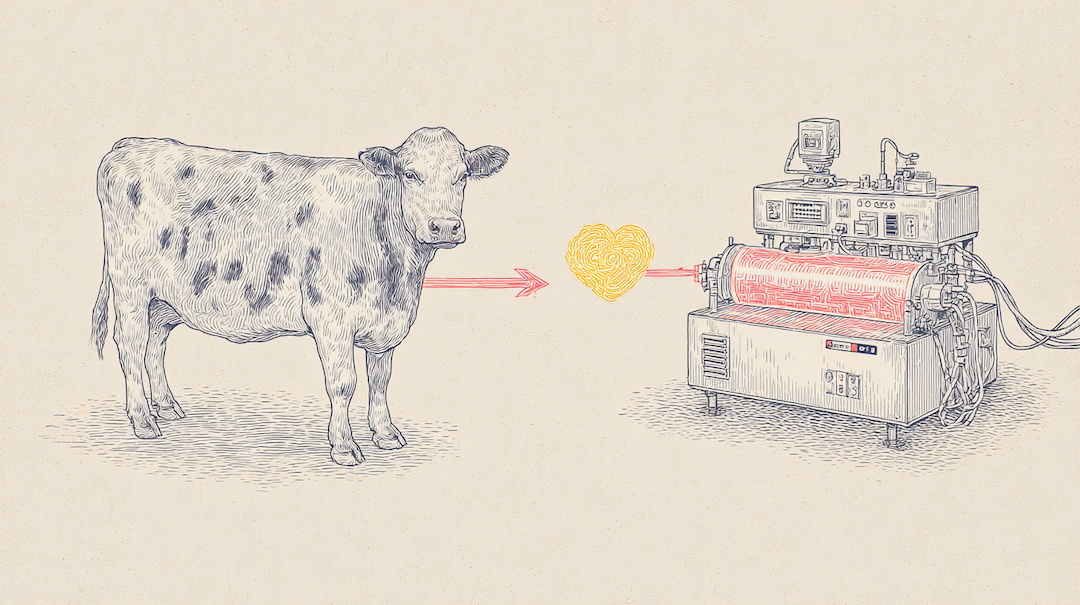
If precision fermentation is going to reshape food production, dairy is the natural starting point. Consider the mathematics: a cow produces milk that is about 3% protein. The other 97% is liquid and fat. You're raising, feeding, housing, and managing an entire animal to capture that 3%. As Jensen explains, "A cow is converting about 4% of the input it takes in. If we can bypass that, because we don't need to replace the milk, we just need to replace the 3% protein that's in the milk, that's a value-add, that's what people are paying to get."
The Israeli startup Remilk has already moved beyond the lab. They've launched a 75,000-square-meter production facility in Kalundborg, Denmark. This isn't theoretical. This is happening at scale, right now.
The tipping point isn't about consumer choice. It's about economics. Jensen describes how adoption will likely unfold: "The first thing that's going to happen is it's going to be an ingredient. So it's going to be mixed in, it's going to be a component, and that is going to drive down prices of technologies even further. And then we, at some time or the other, arrive at a tipping point where this is simply the cheaper solution to producing a lot of the ingredients and the food stuff that we know today. And then it's going to happen because it's a lot cheaper."
This pattern mirrors how other technologies overtake incumbent systems. You don't see the change coming as a dramatic choice. You see it as a small substitution, a minor ingredient in an existing product, until one day the cheaper solution becomes the default and no one consciously chose to make the switch.
The GMO Question and Cultural Skepticism
The conversation about precision fermentation inevitably collides with anxiety about genetic modification. Labels on milk bottles claim "no GMO" as a virtue. The skepticism is understandable but misses a historical point. As Jensen observes, "The cows we have now don't look like the cows we had 50 or 60 years ago."
Humans have been genetically engineering organisms for millennia. We did it through selective breeding, and we did it slowly. CRISPR simply accelerates the process. What's technically true about CRISPR is less threatening than it sounds: properties inserted into microorganisms don't inherit to the next generation. You design for a specific generation, and that's it.
But here's what matters more than the technology debate: you don't actually need CRISPR to get this rolling. Thousands of well-known microorganisms already exist, with properties already understood, requiring no genetic modification at all. As Jensen argues, "We can still do it without genetically modifying, we can still do it with the thousands of well-known microorganisms, where we already know what the output is going to be without modifying it. So we can already get this ball rolling."
The GMO question is real and worth debating. But it's also a convenient place to stall while the underlying technology matures regardless.
A Complete Transformation Looks Gradual Until It Doesn't
The deepest insight from Jensen comes from a report he references: "We are on the cusp of the biggest paradigm change since the domestication of animals 10,000 years ago." Ten thousand years ago, humans moved from hunting and gathering to cultivating specific crops and managing specific animals. Now we're domesticating microorganisms to produce precisely the ingredients we've always needed.
When precision fermentation becomes cheaper than conventional production, adoption won't require a cultural conversion. It won't depend on convincing people to choose differently. It will happen the way most transformations happen: someone will notice that the cheaper solution is just good enough, then better, then obviously better, and the choice becomes invisible.
Fifty years from now, we might look back at industrial animal agriculture the way Jensen suggests: wondering how we ever thought it was a reasonable system at all.
Conclusion
The path to feeding 10 billion people doesn't run through a single technology or a single behavioral shift. It runs through the intersection of multiple forces: improving plant-based products, refining conventional animal agriculture, and perfecting the precision fermentation process that exists in pharmaceutical labs today. Plant-based foods are part of the puzzle, but the more transformative change is happening in steel tanks, where microorganisms produce exact proteins without the biological inefficiency of animals in between.
The real story isn't about choosing between these paths. It's about recognizing what's already in motion: a convergence of technologies that's about to make the current food system look like an expensive intermediary. Consumer preferences will follow economics, not the other way around. The efficiency principle that governs energy systems and computing is now entering food production. Understanding that principle and its implications is more important than choosing which food to buy this week.