TL;DR
- T-Rex did not hunt by motion. The premise of the most quoted line in dinosaur cinema has no support in vertebrate paleontology.
- Skull geometry analysed by paleontologist Kent A. Stevens places the animal's stereoscopic field at about 55 degrees, wider than a hawk's 34 degrees and roughly three times a human's central forward range.
- Best estimates put its visual acuity at around 13 times sharper than a human's, capable of resolving a motionless rabbit at a kilometre.
- The "movement vision" idea was lifted from frog biology. Frogs do hunt this way. Active pursuit predators with forward-facing eyes do not.
- Standing still in front of a real Tyrannosaurus would not have helped. Nothing would have.
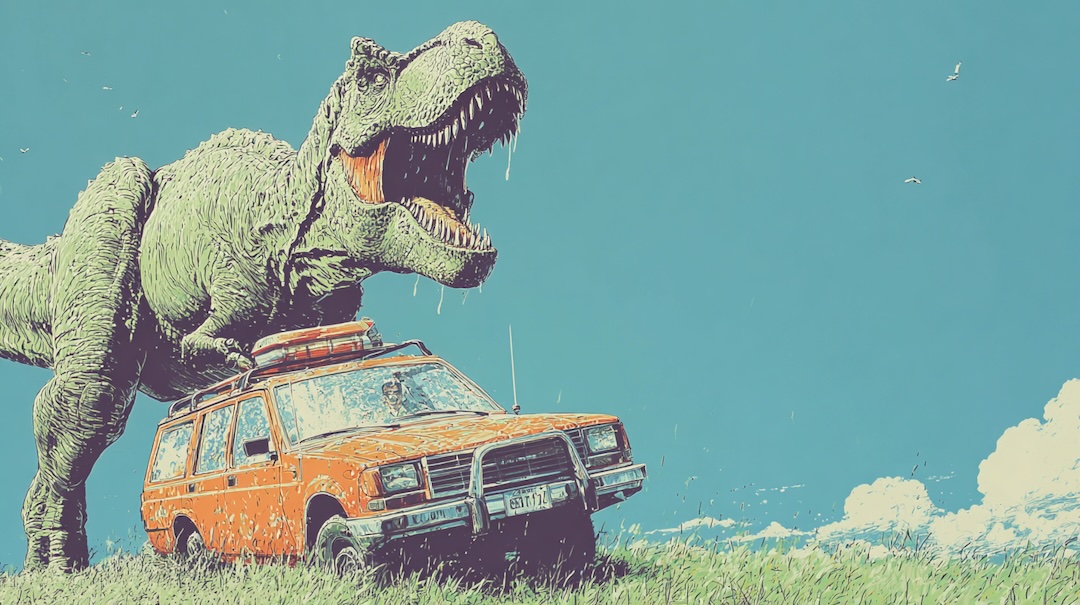
The car. The trembling water in the cup. The voice in the dark. "Don't move. Its vision is based on movement." The most famous instruction in dinosaur cinema is also one of the most consequential pieces of misinformation ever delivered by a fictional mathematician.
The line is in the cultural bloodstream. It shapes how millions of people, including children who grew up to become paleontologists, first imagine Tyrannosaurus Rex. And as a description of the actual animal that walked across Cretaceous North America, it is almost entirely backwards.
The real Tyrannosaurus Rex had vision so refined that it changes the entire visual experience of imagining the animal in the wild. Forward-facing eyes the size of softballs. A stereoscopic field that exceeds every living bird of prey. Acuity comparable to looking through field optics at low magnification. Depth perception engineered by 100 million years of vertebrate evolution.
What follows is the science of how we know, why the movie got it wrong, and why standing still in front of a real T-Rex would have changed precisely nothing.
How a Hollywood line became cultural gospel
The 1993 Jurassic Park scene is so well constructed that it imprints permanently. The camera holds still. The water trembles. Dr. Ian Malcolm whispers the explanation. The animal sniffs, hesitates, and walks away. The audience is taught a biological "fact" with the emotional weight of a survival lesson.
The fact, however, never came from paleontology. It came from a working assumption made by author Michael Crichton, drawing loosely from the visual processing of frogs and certain reptiles. In some cold-blooded ambush predators, the visual system genuinely is wired to suppress static input and respond strongly to motion. A frog will starve next to a pile of dead flies. That is real biology.
The leap from a sit-and-wait amphibian to an 8-tonne pursuit predator with binocular vision is the part that has no biological basis. By the time the movie reached cinemas, the scene was so vivid that the underlying assumption hardened into a fact in popular culture. Three decades on, the idea that T-Rex could not see a motionless human remains one of the most stubbornly held pieces of dinosaur folklore. It survives because the cinema is excellent. The science was never there.
What replaced the folk model is a body of careful anatomical work, much of it built on the geometry of the skull itself, that paints a very different picture of how this animal experienced the world.
What the skull actually says about the eyes
Stereoscopic vision is the capacity to perceive depth by combining the slightly different images produced by two forward-facing eyes. The brain compares the offset between the two images and computes distance. The wider the overlap between the two visual fields, the better the depth resolution within that overlap.
In a 2006 paper in the Journal of Vertebrate Paleontology, paleontologist Kent A. Stevens applied this principle to the skulls of theropod dinosaurs. By measuring the orientation of the eye sockets and modelling the maximum field through which each eye could sweep, he produced quantitative estimates of binocular overlap for several large predators, including Tyrannosaurus Rex.
The Tyrannosaurus result is striking. Its stereoscopic field is calculated at roughly 55 degrees. Modern hawks operate at around 34 degrees. Humans manage somewhere near 120 degrees of overall binocular overlap, but only about 20 degrees in the sharp central region used for depth-critical tasks like threading a needle. Within that central, high-resolution band, T-Rex outperforms not just every modern bird of prey but every land predator alive today.
These numbers come straight from geometry. The orbits in a T-Rex skull face forward to a degree unmatched in modern reptiles. The cheek bones angle in a way that clears the side of the snout from the visual path. Whatever soft-tissue inferences are involved, the bones themselves preserve the architecture of an animal built around forward vision.
This is the foundation. Everything else follows from it.
Visual acuity at predator scale
Visual acuity is the capacity to resolve fine detail at distance. In humans it is limited by the spacing of receptors in the retina and by the optical quality of the lens and cornea. The number we casually call "20/20" sets the floor for normal performance, not the ceiling.
T-Rex had eyes roughly the size of softballs. The optical components of a vertebrate eye scale with size in predictable ways, and a larger eye can resolve finer angular detail simply because more receptors can be packed into the same field. Combining eye size with what is known about visual acuity in living birds, particularly raptors, gives the upper-bound estimates published for theropods. For Tyrannosaurus, those estimates land at around 13 times sharper than human vision.
To translate that into something tangible, imagine standing one kilometre away from a rabbit sitting on a grass field. To you, the rabbit is a possibly-present, possibly-imagined smudge. To a Tyrannosaurus standing in your place, the rabbit is a clear, resolvable target. Movement is not required for detection. The geometry of the eye does the work.
This single number, on its own, dismantles the movie scene. Standing still in front of an animal with hawk-grade optics is not concealment. It is presentation.
Where the motion vision idea actually came from
The "vision based on movement" model is real biology, and it has a clear evolutionary logic. The catch is that the logic does not apply to T-Rex.
In frogs, certain lizards, and a handful of other cold-blooded ambush predators, neural circuits in the eye and midbrain are tuned to detect rapid local changes in the visual field. Static input is processed weakly. Movement triggers a strong, almost reflexive response. The strategy fits an animal that sits still, waits for prey to walk close, and snaps. The neural shortcut conserves energy and reduces the size of the visual brain that a small ectotherm has to maintain.
This is the biology that travelled into Jurassic Park – mainly because the genetic work done by the Jurassic Park scientists included “filling the gabs” in the dino-dna with frog dna.
The transfer from a sedentary ambush hunter the size of a tennis ball to an 8-tonne pursuit predator with forward-facing eyes was always biologically implausible. Active predators that chase prey, and that need to time strikes against moving targets at distance, depend on continuous, high-resolution input. Cutting that signal off in favour of motion-only processing would have been an evolutionary catastrophe.
Forward-facing eyes are not the architecture of a frog. They are the architecture of an animal that needs to compute the position and velocity of moving prey with high precision, in real time, while closing on it.
The evolutionary signature of an apex predator
Forward-facing orbits are a tell. Across the vertebrate world, they appear in lineages that share a common ecological niche, active pursuit predation. Eagles, hawks, owls, big cats, wolves, primates that hunt. The orientation of the orbits is one of the first things a vertebrate paleontologist looks at when reconstructing a predator's hunting style.
Tyrannosaurus carries this signature in the most pronounced form known among large theropods. Compared with earlier and smaller relatives such as Allosaurus, the Tyrannosaurus skull rotates the orbits further forward, expands the binocular overlap, and pushes the snout further out of the visual field. These are not random anatomical accidents. They represent a documented evolutionary trajectory toward better depth perception in a hunter that closed the distance on its prey.
The closest living relatives of dinosaurs, modern crocodilians, offer a useful sanity check. Crocodiles and alligators are not motion-only hunters. They have excellent stationary-target detection, can track at range, and integrate visual cues with other senses to time their strikes. If even the lineage that retained sit-and-wait behaviour kept high-resolution visual capacity, there is no plausible mechanism by which Tyrannosaurus, an animal optimised for active hunting, would have lost it.
The vision system of a real Tyrannosaurus was almost certainly the most refined optical instrument any land predator has ever carried. Standing still would not have removed a target from that instrument. It would have made the target easier to resolve.
Stereoscopic vision as biological rangefinding
A useful cross-domain analogue comes from optics. Stereoscopic rangefinders, used in artillery and naval targeting throughout the twentieth century, work by placing two lenses at a known horizontal separation. The instrument compares the angular offset between the two images and computes the distance to the target. The wider the baseline between the lenses, and the more precisely the offsets are measured, the further the effective range.
A Tyrannosaurus head is, in functional terms, a biological rangefinder of unusually high specification. The eyes sit far apart on a large skull. The orbits angle forward enough to produce a 55-degree overlap zone. The optical quality of the eye itself, scaled up from what is preserved in modern raptors, gives the resolving power needed to use that overlap effectively.
The military analogy is not just a metaphor. The mathematics of depth perception in a biological system and in a coincidence rangefinder are formally similar. Both systems convert angular disparity into distance. Both gain accuracy from wider baselines and finer angular resolution.
What this means is that a real Tyrannosaurus, looking across a Cretaceous floodplain, had the practical capacity of a soldier with mounted optics at standard hunting distances. The visual experience of being prey was very specific. It was not "wait for it to move past you". It was "you have already been resolved, ranged, and targeted".
Conclusion
The science here is not a takedown of a beloved film. It is a correction to a piece of public biology that has been allowed to harden because the cinema is unusually effective. Jurassic Park made the most successful dinosaur the most poorly imagined. The real Tyrannosaurus Rex saw better, computed depth better, and tracked at range better than any living land predator. The architecture is preserved in bone. The mathematics are routine. The conclusion is unambiguous.
What this case demonstrates, more broadly, is how much of an extinct animal's behavioural world can be reconstructed from the geometry of a skull. Vision is not a soft-tissue mystery. It is a function of physical relationships that fossilise cleanly. Once those relationships are measured, the animal walks out of cinematic shorthand and back into biology.
The right reaction to all this is not disappointment in a film. The right reaction is awe at the instrument the real animal carried, and at the science that lets us look through it.
Frequently Asked Questions
Q: Did T-Rex actually have vision based on movement, like in Jurassic Park?
No. The movement-based vision idea was borrowed from frog biology by author Michael Crichton and applied to T-Rex without paleontological support. Skull-based analyses show forward-facing eyes optimised for high-resolution, depth-aware vision, the opposite of a motion-only system.
Q: How sharp was T-Rex eyesight compared to humans?
Estimates derived from eye size and comparisons with modern raptors place its visual acuity at roughly 13 times that of a human at equivalent distance. A motionless rabbit one kilometre away would have been a resolvable target.
Q: What is stereoscopic vision and why does it matter for T-Rex?
Stereoscopic vision is depth perception produced by combining two slightly different images from forward-facing eyes. T-Rex's stereoscopic field is calculated at about 55 degrees, wider than a hawk's 34 degrees. This gave it precise depth and range judgement, the hallmark of an active pursuit predator.
Q: Who first showed that T-Rex had eagle-grade vision?
Paleontologist Kent A. Stevens published the foundational analysis in 2006 in the Journal of Vertebrate Paleontology, measuring binocular overlap in theropod skulls using detailed orbital geometry.
Q: Would standing still have actually worked in front of a real T-Rex?
No. With forward-facing eyes, hawk-grade acuity, and rangefinder-grade stereoscopic depth perception, T-Rex would have already resolved and ranged a stationary human at hunting distance. Movement was never the trigger that mattered.
Source
Stevens, K.A. (2006). Binocular vision in theropod dinosaurs. Journal of Vertebrate Paleontology, 26(2), 321 to 330.