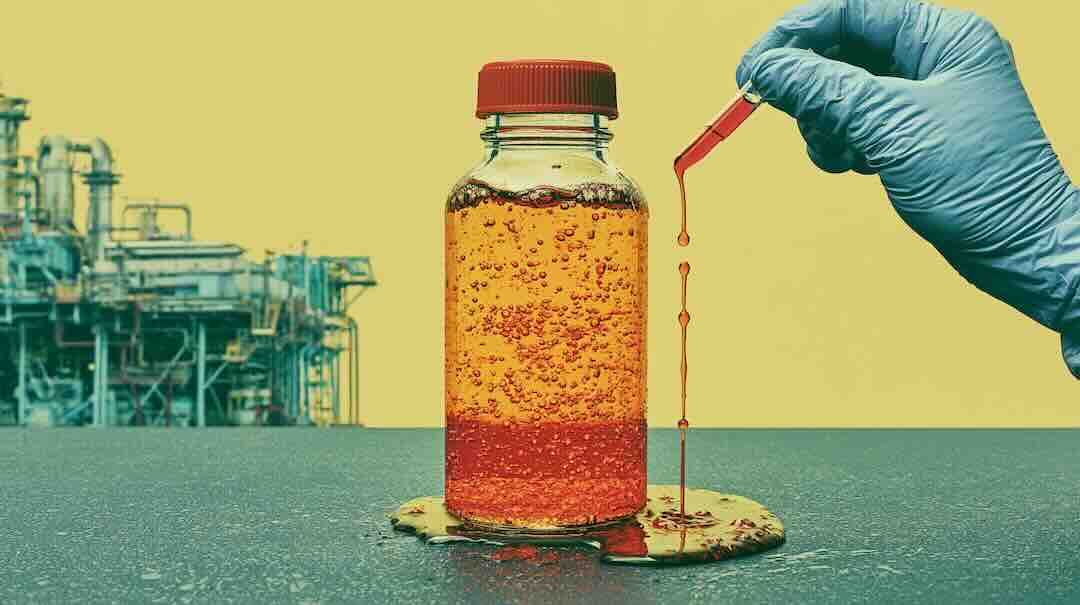
How Crude Oil Learned to Refine Itself
Every barrel of crude that becomes gasoline, jet fuel, or the plastic in your phone passes through the same opening move: heat. Refineries warm crude oil past 350°C until it boils, then catch the different fractions as the vapour cools. It works. It has worked for more than a century. And it is staggeringly expensive. Crude distillation consumes roughly 1,100 terawatt-hours of energy every year worldwide, enough to power about 100 million American homes, or the continuous output of some 130 gigawatt-scale nuclear plants. It is one of the single largest industrial sources of energy use and carbon emissions on the planet.
For decades, the obvious alternative has been sitting in plain sight: instead of boiling crude apart, push it through a membrane and let the molecules sort themselves by size. No heat, no phase change, far less energy. The trouble was always that nobody could make a membrane that was both selective enough to separate something as fine-grained as crude oil and productive enough to matter at industrial scale. The ones precise enough to work were too slow, too fragile, or too expensive to coat across the acres of surface a refinery would need.
A team led by KAIST's Dong-Yeun Koh and Georgia Tech's Ryan Lively found a way through, and the route they took is the interesting part. They didn't engineer a better filter. They got the crude oil to build one for itself.
The flaw that turned out to be the feature
Start with what makes their result counterintuitive. In almost every filtration system ever built, the enemy is fouling, the gradual gunking-up of a membrane as material accumulates inside its pores. Fouling clogs filters, slows flow, and degrades performance. Engineers spend enormous effort designing it out.
The new membrane is made of polyacrylonitrile, or PAN, a cheap, chemically stable polymer so unremarkable that it is normally used as the support layer underneath the part of a membrane that does the real work. On its own, PAN is porous and non-selective. By conventional wisdom it should let everything through, or clog and quit.
What the researchers observed instead was a kind of productive sabotage. As crude oil flowed through the bare PAN, its heaviest, longest hydrocarbon molecules began depositing on the walls of the pores. But rather than blocking the membrane, the buildup narrowed the channels to less than two nanometres across, and at that width, the very molecules that had been doing the depositing could no longer fit inside. They were now excluded at the entrance. What remained were stable, self-assembled passageways that let lighter fractions like naphtha and kerosene stream through while holding the heavy stuff back.
The fouling, in other words, didn't degrade the filter. The fouling was the filter.
A system that organises itself
There is something here that goes beyond chemical engineering, and it is worth pausing on. The membrane wasn't designed with two-nanometre channels. It was designed with crude, oversized pores, and the precise structure emerged from the interaction between the material and the messy mixture flowing through it. The oil carved its own pathways, and then those pathways stabilised because the process that created them was self-limiting: deposition continued until the channels were exactly narrow enough to stop further deposition, and no narrower.
Nature is full of this pattern. Rivers cut channels that then constrain where the river can flow. Footpaths form where people walk, and once formed, they pull the next walker along the same line. Scar tissue lays itself down precisely where a wound demands it. In each case, structure isn't imposed from outside; it precipitates out of a feedback loop between a system and its environment. Koh describes the result in almost those terms: a new scientific principle, he says, in which a membrane interacts with a complex mixture and spontaneously forms its own separation channels. The engineering insight wasn't to build the answer. It was to set up the conditions under which the answer would build itself.
Why it didn't work before
If membranes have promised cheaper refining for years, why does this study matter rather than the dozens before it? The honest answer is productivity. Lively and colleagues had already shown back in 2020 that designer membranes could fractionate crude. The problem was that they did it far too slowly to leave the laboratory. The oil trickled through at rates no refinery could build a business on.
The bare PAN membrane moved crude roughly 23 times faster than that earlier state of the art, and it held its performance steady for 28 days of continuous operation on real crude oil supplied by a working refiner, HD Hyundai Oilbank. Speed and stability are exactly the two walls that kept this idea penned in the lab. "One of the key challenges facing membrane systems for crude oil separation was the low productivity of the membrane units," Lively notes. The PAN membranes, he says, dramatically increase that productivity, to the point where industry should seriously consider adopting the technology.
What it would actually save
The membrane isn't meant to replace distillation outright. The realistic deployment is as a pre-treatment step: skim off a large share of the light hydrocarbons with the membrane first, so that the energy-hungry distillation column has far less material to boil. Because it can be dropped in as a modular unit, refineries wouldn't have to tear out and rebuild their existing infrastructure.
The modelled savings are large. Running the membrane ahead of conventional distillation cut energy use by around 30%, carbon dioxide emissions by roughly 35%, cooling water by about 20%, and operating costs by a third. Applied across US crude distillation capacity, some 18 million barrels a day, the team estimates savings equivalent to powering 2.2 million homes, taking 3 million cars off the road, and supplying water for around 660,000 people each year. Scaled across South Korea's refining sector alone, the cut would be on the order of 10 million tonnes of greenhouse gas a year, about what four million petrol cars emit.
Numbers from a process simulation are not the same as numbers from a built plant, and the gap between the two has swallowed many promising technologies. But the magnitude is the point. Shaving a third off one of the most energy-intensive processes in the industrial world is not a marginal gain.
The wider lesson
The researchers found the same self-channelling behaviour in a second membrane material, which hints that this isn't a one-off quirk of PAN but a more general mechanism waiting to be used. The same trick could apply to purifying the pyrolysis oil recovered from waste plastics, recovering solvents in battery manufacturing, cleaning up pharmaceuticals, or refining biofuels. Anywhere a complex liquid mixture needs to be sorted by molecular size, the principle could hold.
Andrew Livingston of Queen Mary University of London, who wasn't involved, called it "a terrific piece of research that rewards curiosity." That phrase captures the real lesson. The breakthrough didn't come from building a more sophisticated filter. It came from looking hard at something everyone else treated as a defect (fouling, the thing you design out) and asking what it might be good for. As Lively puts it, turning crude into useful products "has relied on essentially the same basic approach for more than a century." The path past that century didn't run through more force. It ran through letting the material do the work, and paying close enough attention to notice when it did.