The Problem We're Actually Solving
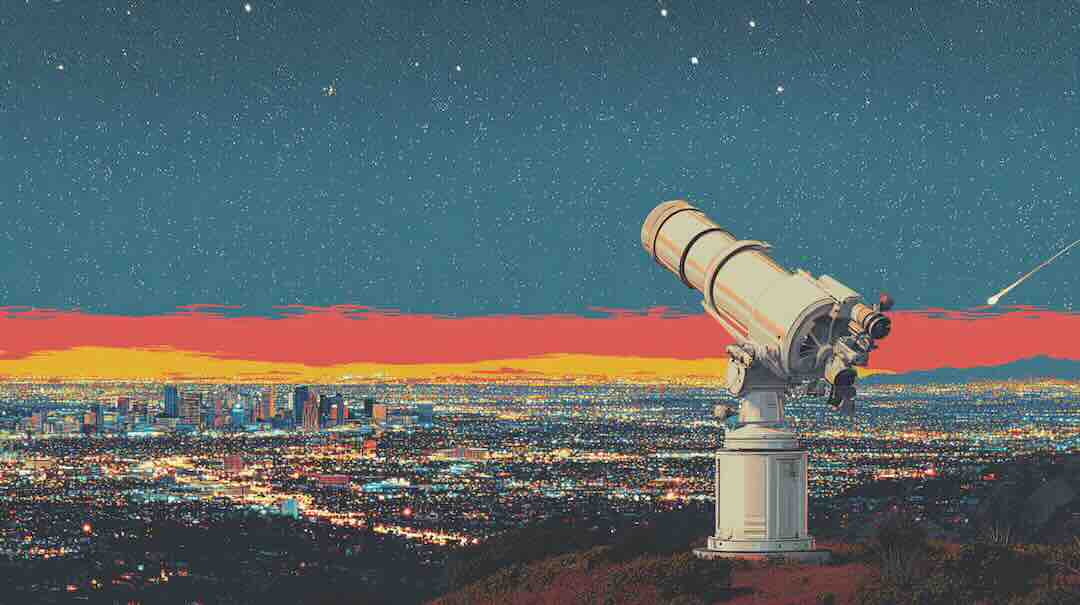
Here's what most people get wrong about telescopes: they think the job is to make things look bigger. In reality, the job is to overcome noise and extract signal from chaos. The atmosphere around Earth flickers constantly. This is why stars appear to twinkle. But a planet doesn't twinkle the same way, because it has angular size.
As Mads explains, "Planets in our solar system doesn't flicker that much because they have an actual size on the sky. And therefore, you would not see this effect that much, but stars are point sources and therefore, the effect gets larger." This distinction matters more than it first appears. The problem isn't the instrument's power to magnify. The problem is the environment between the observer and the observed. For astronomers, that environment is the Earth's atmosphere, a turbulent layer of air that bends and scatters incoming light before it ever reaches the mirror.
Early telescopes were built with lenses. But lenses have a fundamental flaw: gravity. As you make a lens larger to gather more light, its own weight deforms it. Mirror-based telescopes solve this problem differently, because a mirror can be supported across its entire back surface rather than held only at its edges. The evolution from lenses to mirrors was not a minor upgrade. It was a redesign of the entire problem. When the constraint changes, the solution changes with it.
Building Instruments That Correct for Noise
Once you accept that the environment creates noise, the next question becomes: how do you correct for it in real time? This is where adaptive optics enters the picture. Real-time correction systems now adjust a telescope's mirror thousands of times per second to counteract atmospheric distortion. The system detects how the atmosphere is warping the light and physically adjusts the reflecting surface to compensate. What was once considered a hard limit of observation has become a solvable engineering problem.
Mads notes that modern professional telescopes are now fully automated: "Many of the professional telescopes are actually either semiautomatic, fully automatic or robotic as some of ours are. So they run fully by software. No one sits at the telescope during night."
The telescope operates autonomously, guided by algorithms that continuously measure and correct for atmospheric conditions. The human expertise comes at a different layer: in the design of the observation, the interpretation of the data, and the questions being asked in the first place.
The deeper insight is this: noise and signal are not inherent properties of the universe. They're relational. What looks like noise from one perspective becomes signal from another. The job of the instrument is not to eliminate noise but to separate the two and amplify what matters for the question you're trying to answer.
Reading the Universe's Chemical Fingerprints
One of the most powerful discoveries in astronomy came from realizing that you don't need to visit something to understand its composition. You just need to read its light. Spectrographs work by splitting light into its component wavelengths, revealing which wavelengths are absorbed or emitted by different elements. Every atom has a unique fingerprint in the spectrum. Hydrogen looks different from helium, which looks different from iron. By reading these absorption lines, astronomers can determine not just what a star is made of, but sometimes its temperature, density, and motion.
As Mads explains, "We will see some missing light in the spectrum, which then tells us" about the composition of the star. "These are the fingerprints of the atoms and molecules that are in this star." This breakthrough transformed astronomy from a discipline that could only measure how bright something was to a discipline that could measure what it was.
When you approach a star this way, you're not extracting a single piece of information. You're building a detailed catalogue of what it actually consists of, layer by layer, from the same light that an earlier generation could only count for brightness.
Measuring Distance From Earth to the Edge of Time
Astronomy solved one of history's hardest problems: measuring distance to objects you can never reach. The first method was parallax. Imagine standing in one spot, closing one eye, and noting where an object appears against a distant background. Now move several metres and look again. The object appears to have shifted position. The farther away the object, the smaller the apparent shift. By using Earth's orbit as a baseline, roughly 300 million kilometres across, astronomers could measure the distance to the nearest stars using simple geometry.
As Mads describes, "If we observe a close by star, it will look as if it's at some fixed position compared to background stars. When we are at one side of the sun, then we half a year later, goes to the other side, it will actually looks it has moved compared to the background stars with some angle."
But parallax only works for nearby stars. For distant stars, astronomers developed another method: measuring pulsating stars. These stars expand and contract like drums. As Mads puts it, "A big drum sounds deeper in sound as compared to a small one, completely the same with small stars." A pulsating star's oscillation period correlates with its actual size and luminosity. By measuring how fast it pulses and how bright it appears, you can calculate its true distance. Different tools for different scales of the same problem.
Detecting Worlds We Cannot See Directly
The most recent revolution in astronomy is the detection of exoplanets. We can't see them directly. They're too small, too close to their host star, and too dark. Instead, astronomers use two indirect methods. The transit method looks for the tiny dip in starlight when a planet passes in front of its star. For large planets, this dip might be 1 percent of the star's light. For Earth-sized planets, it's far smaller. The second method, radial velocity, detects the Doppler wobble of a star as an orbiting planet's gravity tugs on it. Neither method lets you see the planet. Both methods let you infer its existence with certainty.
As Mads explains, "The largest planet will cause a dip of 1%, maybe of the light that we see. But if you want to go down to Earth-size planets, then it's much less. So you have to have a good telescope with a very good detector."
This represents a profound shift in what "observation" means. In the original sense, observation meant seeing with your own eyes. Modern observation means constructing an inference from indirect evidence. You measure what you can measure and let the mathematics tell you what you cannot see.
The New Generation of Vision
The James Webb Space Telescope represents a leap in scale and capability. Its primary mirror is 6.5 metres across, compared to Hubble's 2.4 metres. More light-gathering power means you can see fainter, more distant objects, which is what lets astronomers reach further back toward the early universe than before.
Webb is tuned to infrared wavelengths, and that choice shapes the rest of its design. Infrared light passes through dust clouds that would block visible light, so the telescope can see into regions that would otherwise stay hidden. To pick up that faint light, the instrument has to stay stable and away from any source of heat, which is why it orbits at Lagrange point 2, roughly 1.5 million kilometres from Earth. That position keeps it clear of the Earth's heat, which would otherwise interfere with infrared observations.
Mads explains what makes the telescope's purpose so focused: "It is made to look at specifically infrared wavelengths. So it's made of gold. It has a gold reflecting surface to be able to measure as much light in this infrared as possible."
The result is an instrument built to answer specific questions about the early universe and to study selected planets around other stars. But Mads is careful about what to expect from a mission like this, because the findings that matter most are often not the ones it was designed to deliver. "Usually, what we see when we have missions like this, it's some of the stuff that has been proposed, why we do it and why we should do it, we get answered. But some of the most amazing stuff is something that no one thought about."
The next step is happening on the ground. The Extremely Large Telescope, currently under construction in Chile, will have a primary mirror approximately 40 metres across, pushing ground-based astronomy to a size never built before. This isn't about incremental improvement. It's about reaching a new regime of observation where questions that are impossible to answer now become answerable.
The history of telescopes is a history of problem-solving at scale. Each generation of astronomers inherited a world where certain questions seemed impossible to answer. Each generation built new instruments, invented new methods, and pushed the boundary of what could be known. The pattern repeats: when you hit a limit, you don't just push harder against the same wall. You build a better instrument.