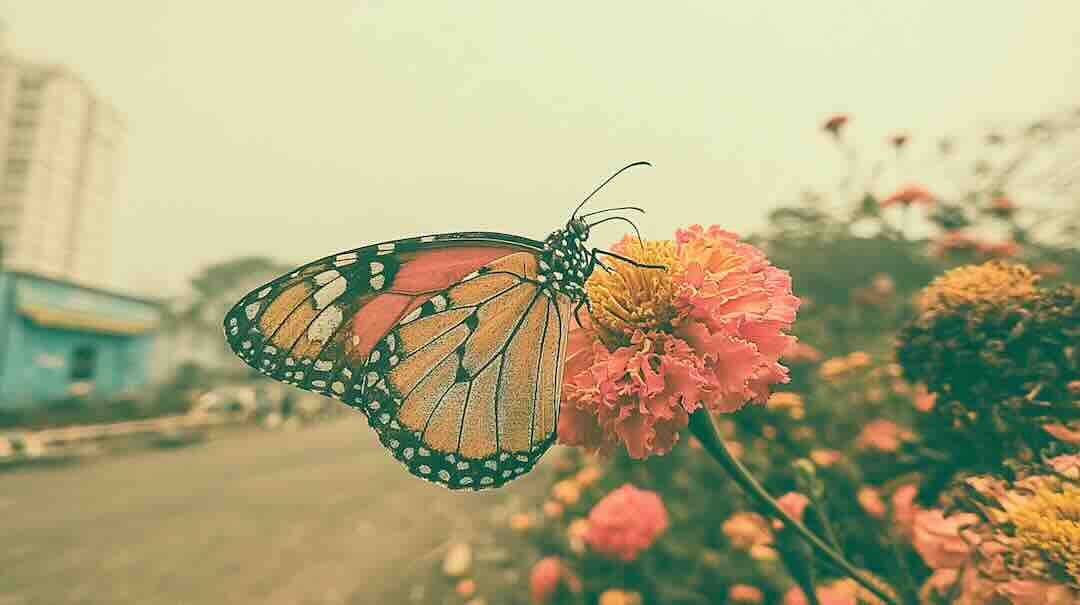
Most butterflies do not get old. They emerge, they mate, they live a few brief weeks, and they die long before anything we would recognise as aging sets in. A relative of the species we are about to discuss, a butterfly called Dione juno, lives a maximum of about 14 days. Against that backdrop, consider Heliconius hewitsoni, a tropical butterfly from the same broad family, which has been recorded living 348 days. That is nearly a year, and it is roughly 25 times the maximum lifespan of its short-lived cousin. The two animals are built from much the same parts. One of them found a way to keep going.
A team led by researchers at the University of Bristol set out to understand how, and what they found is more interesting than a simple longevity record. The Heliconius butterflies do not just live longer. They appear to age more slowly.
The difference between living long and aging slowly
Those two things are not the same, and the distinction is the heart of the study. You can extend a lifespan without touching the rate of decline, the way a candle in a draft-free room burns longer than one in a breeze while still burning at the same rate. What the Bristol team measured was something else: whether older butterflies were still functioning like younger ones. They looked at both actuarial senescence, the rising risk of death with age, and physiological senescence, the bodily decline that comes with it, and found both were slowed.
In other words, a Heliconius does not simply get more days. It spends more of those days in good working order. "What makes them particularly remarkable," the study's lead author Jessica Foley notes, "is that they appear to have evolved not only longer lifespans, but also slower aging." An old Heliconius is, in the ways that matter, still a capable one.
The pollen clue, and why it is not the whole answer
The obvious place to look for an explanation is diet, because Heliconius butterflies do something almost no other butterflies do: they eat pollen. Most butterflies sip nectar, which is essentially sugar water, fuel and little else. Pollen is different. It is rich in protein and amino acids, the raw materials an animal needs to repair tissue and maintain itself over time. A butterfly with a protein supply is a butterfly that can afford upkeep, and upkeep is what slow aging is made of.
It is a tidy story, and the researchers were careful enough to test it rather than assume it. When they raised one long-lived species, Heliconius hecale, without any pollen at all, it kept a substantial share of its longevity advantage. The diet helps, clearly, but it cannot be the entire mechanism. Something heritable, something written into the animal rather than carried in its food, is also holding the aging process back. That single result is what lifts this from a feeding curiosity into a genuine question about how lifespans evolve.
A package, not a trick
The deeper finding is that pollen feeding did not arrive alone. It came bundled with a whole suite of changes, behavioural, neurological, and physiological, that fit together. Pollen is not lying around in convenient piles. To exploit it, a butterfly has to find reliable sources and return to them, day after day, along consistent routes. That is a memory problem, and Heliconius butterflies solved it by investing in their brains. They have markedly enlarged mushroom bodies, the insect brain structures tied to learning and memory, and they forage with a spatial faithfulness that looks a lot like remembering an address.
So the picture is not "butterfly eats pollen, lives longer." It is a chain that loops back on itself. A richer diet supports a bigger, hungrier brain. A better brain supports the kind of patient, route-based foraging that makes the rich diet reliably available. And a foraging strategy that depends on accumulated knowledge only pays off if the animal lives long enough to use that knowledge, which creates evolutionary pressure for a longer, slower-aging life. Each piece makes the others worth having. None of them is the cause on its own.
This is a recurring lesson in biology, and worth holding onto. The traits that define an organism rarely come as separate dials you can turn one at a time. They arrive as packages, co-evolved and interdependent, because the thing that makes one trait advantageous is often the presence of the others.
Why long life and a good memory keep showing up together
Step back from butterflies and the pattern looks familiar. Across very different branches of the tree of life, long lifespans and good memories tend to travel together. Elephants live for decades and famously remember the location of water across vast ranges and long droughts. Parrots and corvids combine unusual longevity with problem-solving and recall. Humans are the extreme case, pairing the longest life of any primate with the largest investment in learning. The common thread is that a long memory is only worth building if you live long enough to use it, and a long life is easier to justify, in evolutionary terms, if there is valuable knowledge to accumulate and apply.
Evolutionary biology has a name for the underlying logic. The body invests in self-maintenance only to the extent that maintenance pays off in surviving offspring. Where life is cheap and short, as it is for a nectar-sipping butterfly that breeds quickly and dies, there is no return on the metabolic cost of repair, so aging runs fast. Heliconius found a niche where sticking around was worth the investment: a dependable protein source, a foraging strategy that rewards experience, and the cognitive equipment to exploit both. Longevity, in this reading, is not a lucky gift. It is what evolution builds when the conditions make a long life pay.
What a butterfly can teach us about getting old
The most useful idea here is also the most quietly radical one. We tend to think of aging as a countdown, a fixed clock ticking at a rate set by physics and bad luck. The Heliconius butterfly is a reminder that the clock is not fixed. Within a single family of insects, evolution has reset the rate of aging by a factor of more than twenty, not by some exotic mechanism but by changing what an animal eats, how it forages, and how much it invests in its brain.
That is why the researchers see these butterflies as more than a natural-history footnote. An animal that stays cognitively sharp across a greatly extended life is a working model of something humans badly want to understand: how to maintain a nervous system over time rather than simply keeping a body alive. The butterfly will not hand us the answer. But it shows that slowed aging is an achievable evolutionary outcome, assembled from ordinary parts, and that the question worth asking is not only how long a life can last, but what kind of life makes lasting worth it.